Loader
| Bucket Capacity | 0.39 yd3 (0.3 m3) |
| Operating Load Rating | 1300 lb (589 kg) |
| Tipping Load | 2600 lb (1178 kg) |
| Bucket Width | 61 in (1540 mm) |
| Maximum Reach | 24 in (600 mm) |
| Hinge Pin Height | 112 in (2845 mm) |
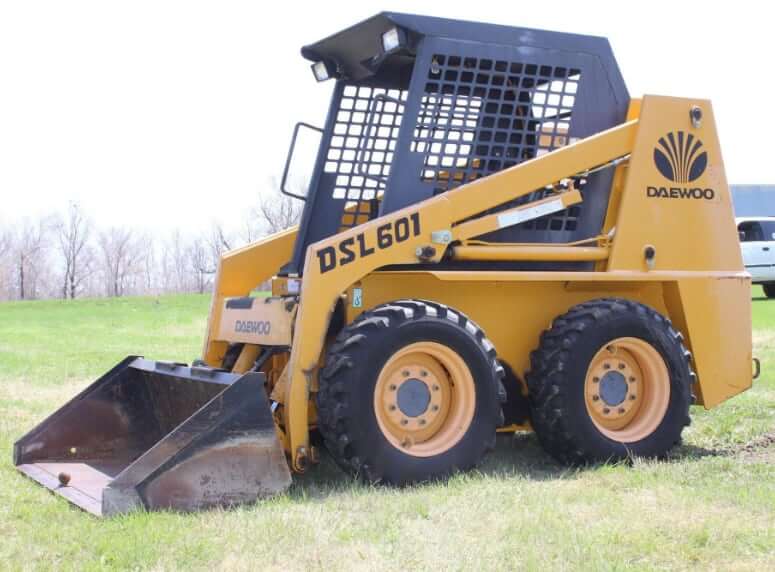
Dimensions
| Overall Width | 61.4 in (1560 mm) |
| Overall Length | 117 in (2970 mm) |
| Wheelbase | 38 in (965 mm) |
| Height to Top of ROPS | 76 in (1930 mm) |
| Hinge Pin Height | 112 in (2845 mm) |
| Ground Clearance | 7.5 in (190 mm) |
Engine Details
| Number Of Cylinders | 4 |
| Engine Make | Yanmar |
| Engine Model | Yanmar 4TNE84-DS |
| Displacement | 122.1 cu in (1.99 L) |
| Bore | 3.31 in (84 mm) |
| Stroke | 3.54 in 90 mm |
| Net Power | 42 hp (31.4 kw) |
| Power Measured @ | 3000 rpm |
| Aspiration | Naturally aspirated |
| Lubricating System | Forcible lubrication by trochoid pump |
Operational Specs
| Operating Weight | 5900 lb (2676 kg) |
| Pump Flow Capacity | 11.9 gal/min (44.9 L/min) |
| Operating Voltage | 12 V |
| Max Travel Speed | 6.6 mph (10.7 km/h) |
| Front Tire Size | 10×16.5 |
| Rear Tire Size | 10×16.5 |
Service Refill Capacities
| Fuel Tank Capacity | 13.8 gal (52.4 L) |
| Cooling System Capacity (w/ Radiator) | 1.6 gal (6.1 L) |
| Engine Oil Capacity | 1.5 gal (5.8 L) |
| Hydraulic Tank Capacity | 6.1 gal (23.1 L) |
| Hydraulic System Capacity | 7.8 gal (29.5 L) |
| Chain Box Capacity (each side) | 1.3 gal (5 L) |
My hydraulics on lifting and tilting is mostly non existent, i have to rev machine wide open to lift empty bucket, the drives are perfect engine runs perfect, i put brand new wheels tires on machine, and have replaced small hyd pump in front of big pump to no avail. I have probally put 2 hrs on machine in 6 years can push or grade with machine and rebuilt the whole front universal hook up system better than it came from factory. I have got over $12 k in machine and have been ripped off $1100 by a pc of crap mechanic who said he could fix machine and needed money to buy parts and the only thing he did was change hyd fluid and had machine for nine months and the only thing he really knows how to do now is avoid me because i am dangerous for his health!!! Someone please help me? (machine is Daewoo 601, 1998 or 1999)
I’m sorry you went through that. The fact that you’ve already replaced the charge/gear pump and the problem didn’t change at all is actually a very useful diagnostic clue. Based on your description:
– Engine runs normally.
– Drive motors pull strongly.
– Lift and bucket tilt are very weak.
– You have to run at full throttle just to lift an empty bucket.
– Problem has been the same for years.
That points away from the engine and toward the implement hydraulic circuit.
Most likely causes:
1. Main implement hydraulic pump is worn or damaged (most likely) – On a machine of this age, the main pump that supplies the lift and tilt functions can wear enough that it no longer develops adequate pressure or flow. Typical symptoms: Drive system still works normally (if it uses a separate circuit or priority flow). Lift and tilt are slow and weak. High engine RPM only helps a little. This would be the first component I’d suspect after replacing the charge pump.
2. Relief valve stuck open or set too low – If the implement relief valve is leaking or stuck partially open: Oil returns to tank instead of building pressure / Loader won’t lift properly / Bucket curl is also weak. This can often be confirmed with a hydraulic pressure gauge.
3. Loader control valve bypassing internally – A worn spool valve can leak internally, reducing pressure to the lift and tilt cylinders. This is less common than pump wear but certainly possible on a 25+ year-old machine.
4. Hydraulic suction problem – Even with new oil, check: Suction hose from tank to pump / Hose clamps / Cracked hoses / Suction strainer inside the tank. A tiny air leak on the suction side can cause cavitation and poor hydraulic performance without leaving an external oil leak.
5. Pressure test before buying more parts – At this point, don’t spend money on more parts until the hydraulics are tested. A technician with a hydraulic pressure gauge can usually determine whether the problem is: the main pump; the relief valve, or the control valve. That test often takes less than an hour and can save replacing expensive components unnecessarily.
Since you’ve already replaced the small pump… The fact that replacing it made no improvement whatsoever makes me think the problem is downstream – most likely the main hydraulic pump or the implement relief valve.